
How AI Learns: Training, Models, and the "Math" of Success
Published by: The Consultancy World
Last Updated: April 2026
Reading Time: 6 Minutes
Level: Beginner to Intermediate
The AI Foundations Library: Lesson 4 of 8
Executive Summary
1. Programming vs. Learning: The CEO's Perspective
In the old world, we gave computers "If/Then" instructions. In the AI world, we give them "Examples."
Traditional Software: Rigid. If a scenario wasn't programmed, the system failed.
AI Learning: Flexible. By seeing 10,000 examples of a "good loan," the AI discovers patterns a human programmer would never think to write down.
CEO Note: Traditional programming tells the computer what to do. AI shows the computer what "good" looks like and lets it figure out the math.
2. The "Kitchen" Metaphor: Ingredients vs. Recipes
Think of Data as your ingredients and the AI Model as the finished dish.
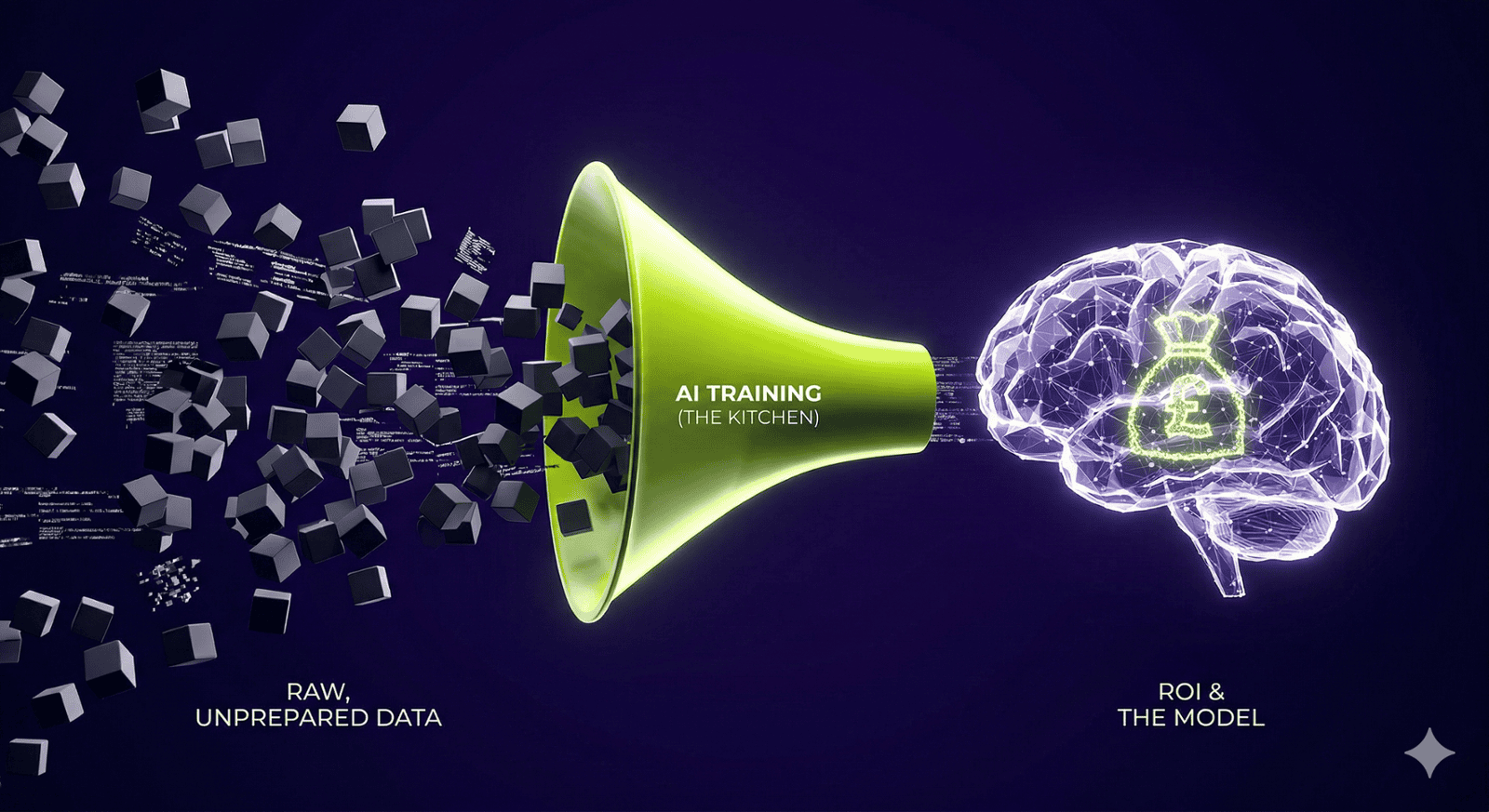
The Ingredients (Training Data): If you give a chef (the AI) 1 million photos of a bridge, the AI doesn't "know" what a bridge is. It simply records the mathematical relationship between pixels.
The Recipe (The Algorithm): This is the set of rules the AI uses to identify patterns.
The Chef (Training): This is the computational process where the AI tries to predict what an image is, gets corrected by a "math score," and adjusts its internal settings until it stops making mistakes.
2. The "Math" of Success: Weights and Biases
When we talk about a "Model," we are talking about a file full of numbers called Weights.
Pattern Recognition: During training, the AI assigns a "Weight" to certain features. For a bank, the AI might learn that "Consistent Income" has a high weight for loan approval, while "Social Media Following" has a weight of zero.
The Success Metric (Loss Function): The math of success is determined by the "Loss Function." This is a mathematical calculation that measures how far the AI's guess was from the truth. Success isn't "thinking"; it is the mathematical minimisation of error.
3. The Three Stages of AI "Knowledge"
To manage an AI project, you must understand where your model sits in this lifecycle:
Pre-Training (The Generalist): The AI reads the entire internet. It learns how humans speak but knows nothing about your business.
Fine-Tuning (The Specialist): You pour your company’s specific data (Image 4's "Raw Data") into the funnel. The AI learns your brand voice, your product codes, and your customer history.
Inference (The Employee): This is the "ROI Phase." The training is over. The math is set. Now, when a customer asks a question, the AI uses its "Weights" to calculate the most helpful answer in milliseconds.
4. Why "More Data" Isn't Always the Answer
The "Math of Success" relies on Signal-to-Noise Ratio.
If you feed the funnel 10,000 bad rows of data and 1,000 good ones, the "Math" will prioritize the bad patterns.
Consultancy Insight: ROI is found in curated data, not just "big data." Success is achieved when the "Math" is applied to the most accurate representation of your business truth.
Executive Takeaway
You don't need to know the calculus, but you must know that AI is a Probability Engine, not a Truth Engine. It doesn't 'know' the answer; it calculates the most likely version of the truth based on the data you fed into the funnel.